When new to practicing the Christian faith, a beginner will usually have a number of questions. For example, should you pray reading a previously written prayer vs. free prayer, or can a prayer be spoken freely, in the moment? What does the Bible have to say about prayer?
Written Prayer Vs. Free Prayer
God wants to hear our prayers, and so your prayer time is found in the moment you communicate with God, whether you speak openly or inside your mind, or you’re reading a prayer or just saying what’s in your heart at that moment. Beginners often rely on a written prayer, and there’s nothing wrong with that. However, even beginners should understand that God wants to hear from you, whether you’re new to praying or you’ve been doing it all your life.
The Bible has a myriad examples of written prayer, which are commonly used today under a wide variety of circumstances; from giving blessings to asking for courage, or giving thanks for something in particular.
The only difference between a pre written prayer vs. free prayer is that it helps you to focus on a particular topic. Free prayer is often given in the spur of the moment. God wants to hear from us, whether it’s from a written prayer or given freely and off-the-cuff. Regardless, the important thing to always remember is that you must pray with honesty, humbleness, respect and in faith.
Your faith and belief in prayer is essential.
The Most Famous Written Prayer of All
A number of prayers can be found throughout the Old and New Testaments of the Bible. One of the most commonly said prayers in church is the Lord’s Prayer, given to us by Jesus Christ during the Sermon on the Mount. It can be found in the New Testament Gospels of Matthew (6:9-13) and Luke (11:2-4). This is one of the most famous written prayers:
Our Father, who art in heaven, hallowed be thy name. Thy kingdom come, Thy will be done on earth as it is in heaven. Give us this day our daily bread and forgive us our debts, as we forgive our debtors. Do not lead us into temptation, but deliver us from the evil one. For Thine is the kingdom and the power and the glory forever, Amen.
Over the centuries, some of the words have been changed. For example, debts has become trespasses. Even so, the important thing to remember is not to just say the words automatically, but to understand what Jesus was trying to tell us when offering us this prayer as an example of how to pray.
In that written prayer alone, and in faith and humbleness, you are honoring God the Father. You are acknowledging His kingdom, and that it is His will that is done, not yours. We ask for sustenance. We ask for forgiveness for doing wrong to others, and our ability to forgive those who do wrong to us. Finally, we are reminded of the power, divinity, and kingdom of the Almighty, who created everything, and gave us His son, Jesus Christ to save us. As such, believing in God and in His son, Jesus Christ is an important aspect of prayer as well.
How Should Beginners Pray: Written Prayer Vs. Free Prayer?
There is no set rule for how someone new to the Christian faith or praying should pray. Whether you’re saying a prayer that’s written in the Holy Bible or in a book of prayers, or one that you have written on your own, it is perfectly acceptable to “read” that prayer to God. Just remember to say the words with meaning and understanding. Avoid rushing through a written prayer just because it’s easier.
What about free prayer? For a beginner, a written prayer vs. free prayer might be easier and less worrisome that you might be praying ‘wrong’, but always remember that God wants to hear from you. He wants to know what’s in your heart. While many written prayers are more formal in nature, when you turn to free prayer, you’re speaking in a more personal manner to God the Father and His Holy Son. Free prayer is one that often comes straight from the heart, in the moment, and can be one sentence long or as long as you want it to be. The key is to believe that your prayer will be heard. Your belief will solidify your faith and belief in God and His son Jesus Christ, which is one of the more personal requirements of prayer.
In the New Testament book of John (14:13), Christ says, “And whatever you ask in My name, that I will do, that the Father may be glorified in the Son. If you ask anything in My name, I will do it. If you love Me, keep My commandments. And I will pray the Father, and He will give you another Helper, that He may abide with you forever, even the Spirit of truth, whom the world cannot receive, because it neither sees Him nor knows Him; but you know Him, for He dwells with you and will be in you.”
Prayer Time
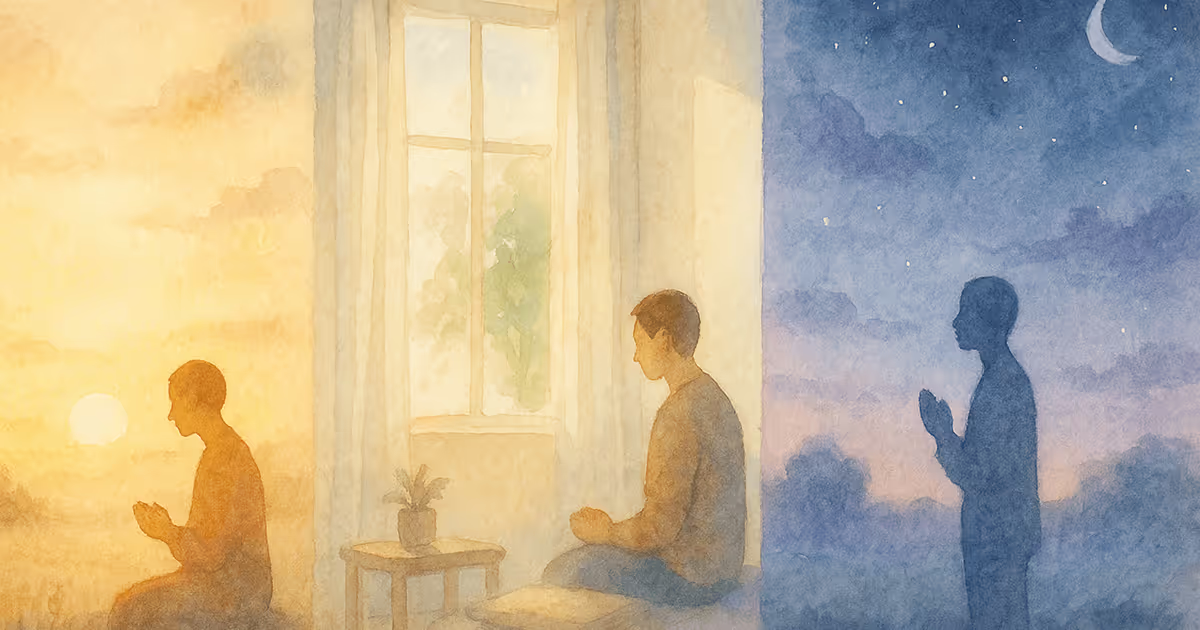
During your prayer time, which can be anytime during the day or night, lifting your thoughts, heart, and soul to God in the heavens is a prayer - a direct communication between you and God, your faith, your belief, trust, and respect. Your prayer time, whether you’re reading from a written prayer vs. free prayer, always do so with the focus of your entire being. It should come directly from your soul. Even if you’re reading a previously written prayer, take the time to really read it and understand what those words mean.
Sometimes, when using repetitive or common prayers, it can become ‘routine’ – this risks a person not really focusing or paying much attention to the words themselves. So, bottom line, is there much of a difference between written prayer vs. free prayer? Not really, as long as you believe what you’re saying and that you understand that your prayer, through your faith and belief, will reach God’s ears.